项目 / bowang-lab/MedRAX
面向胸部 X 光片的医学推理智能体,用来把多种专项模型组合起来,完成复杂查询的多步研究实验。这是研究原型,不是诊疗软件,源文没有把它写成可替代临床判读的产品。可按仓库说明安装后运行 `python main.py` 打开 Gradio 界面,并自行配置模型目录和所需接口密钥。
本站整理,非 GitHub 官方 description。
官方快照(gh_history.db,2026-11-25):总榜 未进 Top50 · 日榜 未进 Top50 · 周榜未满 7 天基线(官方不生成) · 月榜暂无官方口径;下方四卡为站内趋势聚合(周卡按上榜次数,非官方 7 日增量窗)。
以下三段按该项目自己的 GitHub README 章节摘录(可合理截断并标明);README 没有对应章节的留空,不编造。
可运行 python main.py。
基于 LangChain 和 LangGraph 构建,主模型使用带视觉能力的 GPT-4o,可本地或云端部署,界面用 Gradio。工具层可接入视觉问答、分割、定位、报告生成、疾病分类和合成影像等研究组件,并可按需注释掉没有权限的工具。配套的 ChestAgentBench 用于评测复杂查询,可在 Hugging Face 下载。本页只按源文写研究与评测用途,不把它表述为诊疗效果。
运行 MedRAX 需要 Python 3.8 及以上版本,且配合 CUDA/GPU 才能获得最佳性能。
来自 GitHub 仓库 README / 主页介绍正文,原样摘录,共 9,305 字节。
<h1 align="center">
🤖 MedRAX: Medical Reasoning Agent for Chest X-ray
</h1>
<p align="center"> <a href="https://arxiv.org/abs/2502.02673" target="_blank"><img src="https://img.shields.io/badge/arXiv-ICML 2025-FF6B6B?style=for-the-badge&logo=arxiv&logoColor=white" alt="arXiv"></a> <a href="https://github.com/bowang-lab/MedRAX"><img src="https://img.shields.io/badge/GitHub-Code-4A90E2?style=for-the-badge&logo=github&logoColor=white" alt="GitHub"></a> <a href="https://huggingface.co/datasets/wanglab/chest-agent-bench"><img src="https://img.shields.io/badge/HuggingFace-Dataset-FFBF00?style=for-the-badge&logo=huggingface&logoColor=white" alt="HuggingFace Dataset"></a> </p>

<br>
## Abstract
Chest X-rays (CXRs) play an integral role in driving critical decisions in disease management and patient care. While recent innovations have led to specialized models for various CXR interpretation tasks, these solutions often operate in isolation, limiting their practical utility in clinical practice. We present MedRAX, the first versatile AI agent that seamlessly integrates state-of-the-art CXR analysis tools and multimodal large language models into a unified framework. MedRAX dynamically leverages these models to address complex medical queries without requiring additional training. To rigorously evaluate its capabilities, we introduce ChestAgentBench, a comprehensive benchmark containing 2,500 complex medical queries across 7 diverse categories. Our experiments demonstrate that MedRAX achieves state-of-the-art performance compared to both open-source and proprietary models, representing a significant step toward the practical deployment of automated CXR interpretation systems.
<br><br>
## MedRAX
MedRAX is built on a robust technical foundation:
- **Core Architecture**: Built on LangChain and LangGraph frameworks
- **Language Model**: Uses GPT-4o with vision capabilities as the backbone LLM
- **Deployment**: Supports both local and cloud-based deployments
- **Interface**: Production-ready interface built with Gradio
- **Modular Design**: Tool-agnostic architecture allowing easy integration of new capabilities
### Integrated Tools
- **Visual QA**: Utilizes CheXagent and LLaVA-Med for complex visual understanding and medical reasoning
- **Segmentation**: Employs MedSAM and PSPNet model trained on ChestX-Det for precise anatomical structure identification
- **Grounding**: Uses Maira-2 for localizing specific findings in medical images
- **Report Generation**: Implements SwinV2 Transformer trained on CheXpert Plus for detailed medical reporting
- **Disease Classification**: Leverages DenseNet-121 from TorchXRayVision for detecting 18 pathology classes
- **X-ray Generation**: Utilizes RoentGen for synthetic CXR generation
- **Utilities**: Includes DICOM processing, visualization tools, and custom plotting capabilities
<br><br>
## ChestAgentBench
We introduce ChestAgentBench, a comprehensive evaluation framework with 2,500 complex medical queries across 7 categories, built from 675 expert-curated clinical cases. The benchmark evaluates complex multi-step reasoning in CXR interpretation through:
- Detection
- Classification
- Localization
- Comparison
- Relationship
- Diagnosis
- Characterization
Download the benchmark: [ChestAgentBench on Hugging Face](https://huggingface.co/datasets/wanglab/chest-agent-bench)
```
huggingface-cli download wanglab/chestagentbench --repo-type dataset --local-dir chestagentbench
```
Unzip the Eurorad figures to your local `MedMAX` directory.
```
unzip chestagentbench/figures.zip
```
To evaluate with GPT-4o, set your OpenAI API key and run the quickstart script.
```
export OPENAI_API_KEY="<your-openai-api-key>"
python quickstart.py \
--model chatgpt-4o-latest \
--temperature 0.2 \
--max-cases 2 \
--log-prefix chatgpt-4o-latest \
--use-urls
```
<br>
## Installation
### Prerequisites
- Python 3.8+
- CUDA/GPU for best performance
### Installation Steps
```bash
# Clone the repository
git clone https://github.com/bowang-lab/MedRAX.git
cd MedRAX
# Install package
pip install -e .
```
### Getting Started
```bash
# Start the Gradio interface
python main.py
```
or if you run into permission issues
```bash
sudo -E env "PATH=$PATH" python main.py
```
You need to setup the `model_dir` inside `main.py` to the directory where you want to download or already have the weights of above tools from Hugging Face.
Comment out the tools that you do not have access to.
Make sure to setup your OpenAI API key in `.env` file!
<br><br><br>
## Tool Selection and Initialization
MedRAX supports selective tool initialization, allowing you to use only the tools you need. Tools can be specified when initializing the agent (look at `main.py`):
```python
selected_tools = [
"ImageVisualizerTool",
"ChestXRayClassifierTool",
"ChestXRaySegmentationTool",
# Add or remove tools as needed
]
agent, tools_dict = initialize_agent(
"medrax/docs/system_prompts.txt",
tools_to_use=selected_tools,
model_dir="/model-weights"
)
```
<br><br>
## Automatically Downloaded Models
The following tools will automatically download their model weights when initialized:
### Classification Tool
```python
ChestXRayClassifierTool(device=device)
```
### Segmentation Tool
```python
ChestXRaySegmentationTool(device=device)
```
### Grounding Tool
```python
XRayPhraseGroundingTool(
cache_dir=model_dir,
temp_dir=temp_dir,
load_in_8bit=True,
device=device
)
```
- Maira-2 weights download to specified `cache_dir`
- 8-bit and 4-bit quantization available for reduced memory usage
### LLaVA-Med Tool
```python
LlavaMedTool(
cache_dir=model_dir,
device=device,
load_in_8bit=True
)
```
- Automatic weight download to `cache_dir`
- 8-bit and 4-bit quantization available for reduced memory usage
### Report Generation Tool
```python
ChestXRayReportGeneratorTool(
cache_dir=model_dir,
device=device
)
```
### Visual QA Tool
```python
XRayVQATool(
cache_dir=model_dir,
device=device
)
```
- CheXagent weights download automatically
### MedSAM Tool
```
Support for MedSAM segmentation will be added in a future update.
```
### Utility Tools
No additional model weights required:
```python
ImageVisualizerTool()
DicomProcessorTool(temp_dir=temp_dir)
```
<br>
## Manual Setup Required
### Image Generation Tool
```python
ChestXRayGeneratorTool(
model_path=f"{model_dir}/roentgen",
temp_dir=temp_dir,
device=device
)
```
- RoentGen weights require manual setup:
1. Contact authors: https://github.com/StanfordMIMI/RoentGen
2. Place weights in `{model_dir}/roentgen`
3. Optional tool, can be excluded if not needed
<br>
## Configuration Notes
### Required Parameters
- `model_dir` or `cache_dir`: Base directory for model weights that Hugging Face uses
- `temp_dir`: Directory for temporary files
- `device`: "cuda" for GPU, "cpu" for CPU-only
### Memory Management
- Consider selective tool initialization for resource constraints
- Use 8-bit quantization where available
- Some tools (LLaVA-Med, Grounding) are more resource-intensive
<br>
### Local LLMs
If you are running a local LLM using frameworks like [Ollama](https://ollama.com/) or [LM Studio](https://lmstudio.ai/), you need to configure your environment variables accordingly. For example:
```
export OPENAI_BASE_URL="http://localhost:11434/v1"
export OPENAI_API_KEY="ollama"
```
<br>
### Optional: OpenAI-compatible Providers
MedRAX supports OpenAI-compatible APIs, allowing regional or local LLM providers to serve as alternative backends.
For example, to use **Qwen3-VL** via [Alibaba Cloud DashScope](https://bailian.console.aliyun.com/?tab=model#/model-market), set the following environment variables:
```bash
export OPENAI_BASE_URL="https://dashscope.aliyuncs.com/compatible-mode/v1"
export OPENAI_API_KEY="<your-dashscope-api-key>"
export OPENAI_MODEL="qwen3-vl-235b-a22b-instruct"
```
<br>
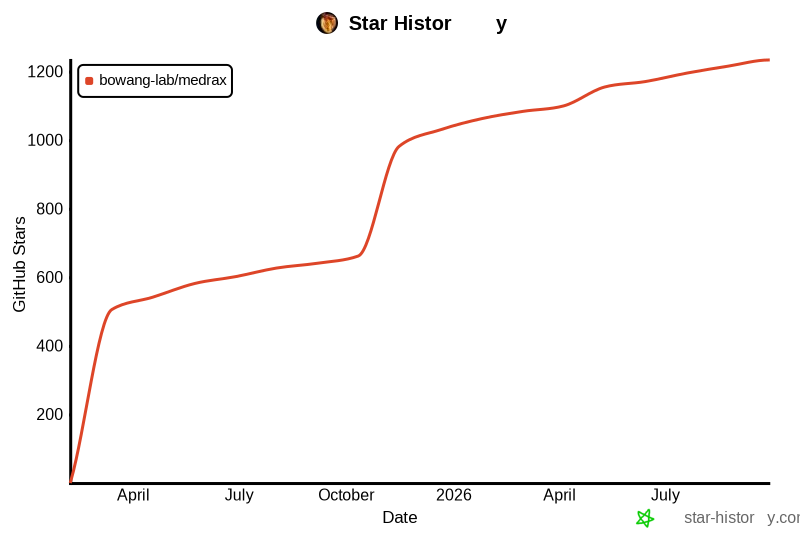
## Star History
<div align="center">
[](https://star-history.com/#bowang-lab/MedRAX&Date)
</div>
<br>
## Authors
- **Adibvafa Fallahpour**¹²³⁴ * (adibvafa.fallahpour@mail.utoronto.ca)
- ****Jun Ma****²³ *
- **Alif Munim**³⁵ *
- ****Hongwei Lyu****³
- ****Bo Wang****¹²³⁶
¹ Department of Computer Science, University of Toronto, Toronto, Canada <br>
² Vector Institute, Toronto, Canada <br>
³ University Health Network, Toronto, Canada <br>
⁴ Cohere, Toronto, Canada <br>
⁵ Cohere Labs, Toronto, Canada <br>
⁶ Department of Laboratory Medicine and Pathobiology, University of Toronto, Toronto, Canada
<br>
* Equal contribution
<br><br>
## Citation
If you find this work useful, please cite our paper:
```bibtex
@misc{fallahpour2025medraxmedicalreasoningagent,
title={MedRAX: Medical Reasoning Agent for Chest X-ray},
author={Adibvafa Fallahpour and Jun Ma and Alif Munim and Hongwei Lyu and Bo Wang},
year={2025},
eprint={2502.02673},
archivePrefix={arXiv},
primaryClass={cs.LG},
url={https://arxiv.org/abs/2502.02673},
}
```
---
<p align="center">
Made with ❤️ at University of Toronto, Vector Institute, and University Health Network
</p>
